
Surgical-free ECG Monitoring in Mice: Feasibility of a Telemetry Harness
Agathe CAMBIER, Clemence NADJAR, Charles EYNARD, Timothe FLENET
ETISENSE R&D, Lyon, France.
Abstract
INTRODUCTION: While ECG monitoring in mice is vital for biomedical research, acquiring high-quality data remains challenging due to the technical complexity of current protocols. Although implantable telemetry is the gold standard for tracking freely moving subjects, its invasive nature necessitates major surgery and extensive post-operative recovery. This project evaluates the feasibility of a miniaturized wearable device specifically engineered for the unique constraints of murine size and behavior. This innovation aims to provide ECG monitoring, ensuring high signal fidelity while significantly enhancing animal welfare.
Materials and Methods
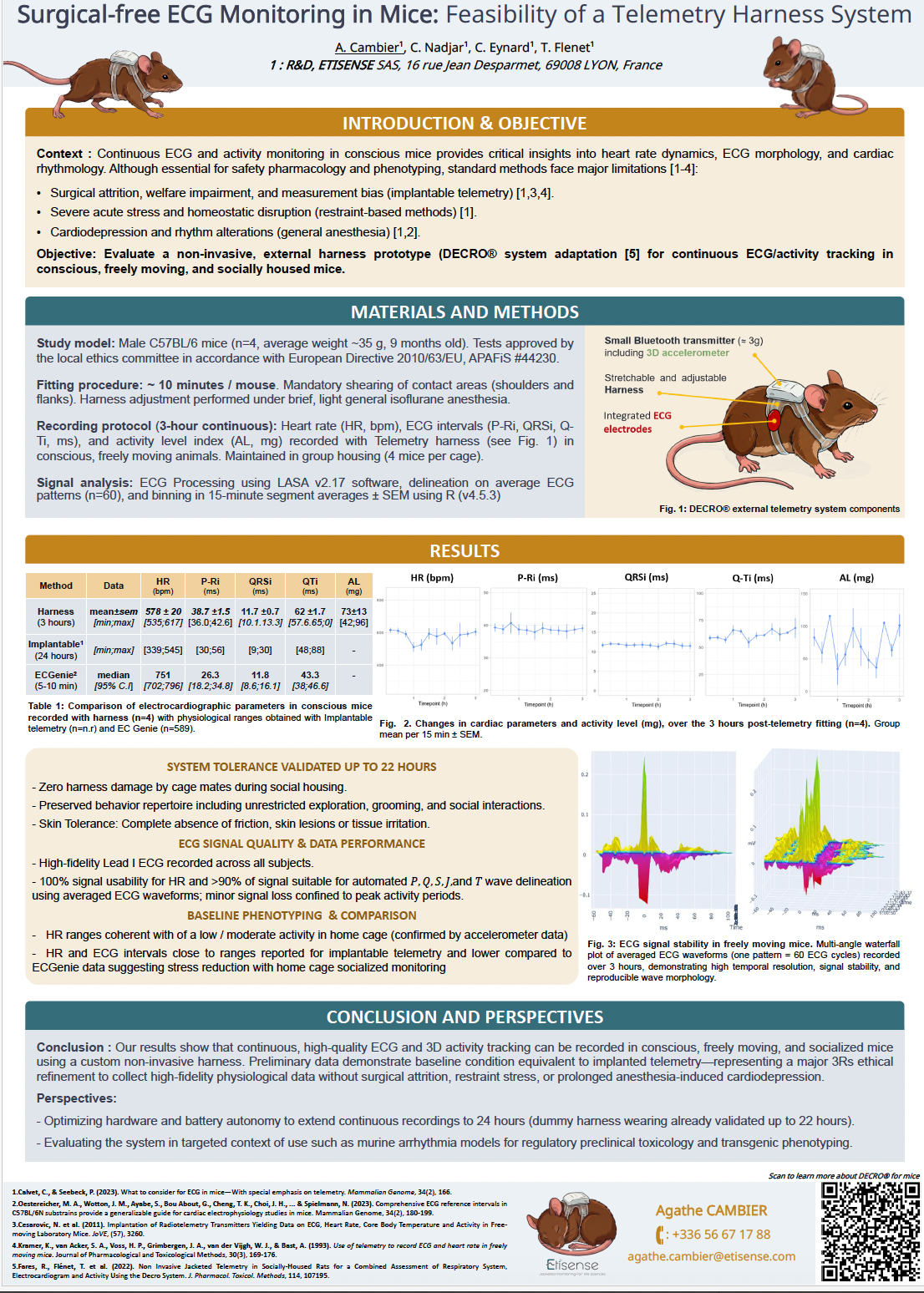
All procedures were approved by the local ethical committee. A 3.5g adjustable harness with embedded ECG electrodes was developed for the murine model. The system was evaluated using male C57BL/6 mice (n=4, ≃35g, 9 months old). Following fur removal and fitting under brief, light anaesthesia, continuous 3-hour ECG acquisition was performed. Animals were socially housed in their home cages during recordings to assess device stability, signal quality, and behavioural tolerance. For analysis, data were averaged in 15-minute bouts.
Results
No equipment was lost or damaged by cage mates. During the test, the subjects exhibited a range of behaviours, including exploration, grooming, and social interactions. High-quality Lead I ECG signal was recorded in all animals. Regarding data yield, 100% of the 15-minute bouts were exploitable for Heart Rate (HR) analysis; over 90% remained suitable for precise waveform delineation (P, Q, S, J, and T waves), with minor losses only during high-intensity activity. Average heart rate (HR) were 577 ±81 bpm. Average P-Ri, QRSi and Q-Ti were respectively 39±3 ms, 12±2 ms and 63±9 ms.
Conclusion
External ECG monitoring was successfully achieved in the murine model, with HR and key intervals recorded within physiological ranges. These results demonstrate the feasibility of a miniaturized telemetry harness and confirm that non-invasive wearable technology can be effectively scaled down for species smaller than rats. By eliminating surgery and restraint, this innovation combines data quality with significant welfare improvements. Future studies will extend recording periods to 24 hours and include younger animals to effectively cover diverse pathophysiological conditions.