
Advancing Minipig physiological monitoring with an enhanced jacketed telemetry solution
Cambier, Agathe1 ; Nadjar, Clémence1; VOLLE, Guillaume1; Søgaard, Susi2; Birch, Pernille2 ; Brodersen, Katrine2;
VHoeg Thygesen, Charlotte2; Latzko, Marie3; Baudet, Stéphane3; Chirat, Sophie3; Eynard, Charles1; Flenet, Timothé1
1 ETISENSE, Lyon, RHONE, France.
2 Ellegaard Göttingen Minipigs, Dalmose, Denmark
3 Charles River Safety Assessment, Lyon, France
Abstract
Despite M3(R2) guidelines from the ICH that encourage incorporating 24-hour safety endpoints
into toxicology studies in large mammals like minipigs, many researchers still prefer using
implanted telemetry in standalone studies or short “snapshot” recordings. Persistent challenges
with external telemetry, such as unreliable ECG patch adhesion, complex cable management, and
equipment damage, often compromise data quality and animal welfare.
To address these issues, this work, conducted in the context of the EU-funded research NHPIG
project(supported by the IHI JU under grant agreement No101165643), introduces an improved
design for external telemetry recording, featuring an ergonomic harness and an adjustable jacket
with integrated ECG electrodes and respiratory inductance bands woven directly into the jacket’s
fabric. This seamless integration improves animal comfort as it requires no shaving or overshirt
and can fit minipigs ranging from 10 to 35kg with only two jacket sizes.
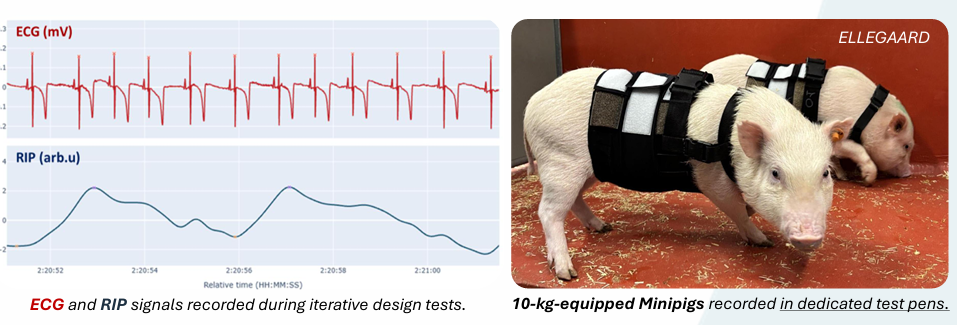
The development was performed at Ellegaard facilities, and initial performances evaluations
were conducted at Charles River Safety Assessment as part of the pretest phase of a 13-week
toxicology study. This jacket demonstrated stable reproducible and robust ECG and respiratory
signals. Minipigs showed excellent device acceptance and no equipment damage for 48 hours of
fitting. As a result, the telemetry device captured 24-hour physiological profiles for individually
housed minipigs [10kg; 4/5 months], showing heart rate of 105±12bpm (mean+SD), respiratory
rate of 19±9brpm, and activity of 17±32milli-g.
Initial trials have demonstrated the benefits of this new standard, yielding high-quality data over
48 hours with 100% animal acceptance. Next steps within the NHPIG project aims to integrate
video tracking and testing during positive control and group-housed studies, to validate a
comprehensive Digital Housing solution (iPig) for minipigs. This technology supports the
M3(R2) recommendations, facilitating a shift from invasive or ‘snapshot’ methods toward
continuous external telemetry that enhances both animal welfare and data relevance.
Acknowledgment: This project is supported by the Innovative Health Initiative Joint Undertaking (IHI JU) under grant agreement No 101165643. The JU receives support from the European Union’s Horizon Europe research and innovation programme and COCIR, EFPIA, Vaccines Europe, EuropaBio and MedTech Europe and Breakthrough T1D and VeriSIM Life.